| Letter |
Term/Technique/Material/Tools |
Photo |
A
|
|
|
| |
Acetone
Acetone is the organic compound. This colorless, mobile, flammable liquid is miscible with water and serves as an important solvent in its own right, typically as the solvent of choice for cleaning purposes in the laboratory. Also used for transferring purposes. |
 |
| |
Acrylic Paint
Acrylic paint is fast drying paint containing pigment suspension in acrylic polymer emulsion. Acrylic paints can be diluted with water, but become water-resistant when dry. It Is used as a wash to antique surfaces, add color and depth, fill stamps and applied to cured/raw clay, to antique allow paint to dry and than wipe with cloth or sand lightly to remove top layer. Can be cured to set. |
 |
| |
Acrylic Sealant (or Varnish)
An acrylic-based finish (or varnish) usually applied over cured polymer clay. Acrylic sealants are available in gloss, satin, or matte finish. Not every varnish found in craft stores is suitable for polymer clay work, some may interact with polymer clay and stay sticky for ever. Check before applying on a big-size project and always prefer the polymer clay manufacturers varnish to make sure you are applying the correct type. |
 |
| |
Air-Dry Clay
A similar material but not identical to polymer clay. Several brands available. This material is air dried and not cured in oven heat. Since its properties are different than polymer clay, not all techniques can be adapted to this material. |
 |
| |
Alcohol (95%)
Used for cleaning hands, work surface, and polymer clay pieces. |
 |
| |
Antique
Antique pieces usually have a bit rusted, ancient look. To antique a new item, artificial patinas are applied. For polymer clay, such patinas may be added using acrylic paints which are brushed over the piece and than removed from the top surface with sanding paper/baby wipes (depending on the desired effect) while leaving it in crevices. (photo - Studio Sculpey - Antiquing Medium) |
 |
| |
Applique
Means, to apply on top of something |
|
| |
Armature
An internal structural base for a sculpture or even jewelry and beads. The armature could be made out of wire, foil, paper, or other materials. It is widely used with polymer clay to add strength to sculpted pieces and to reduce the amount of clay needed for sculpting (big polymer clay pieces, for example). Armature may be permanent (left in the clay sculpture) or temporary (removed after baking). |
|
| |
Art Clay Silver (ACS)
A brand of PMC (Precious Metal Clay). |
|
| |
Artistic Wire
Colored copper craft wire - Artistic Wire Ltd offers extensive line of colored wire, Colored Copper Wire and Silver Plated Wire is available in fifty five (55) colors and thirteen (13) gauges.
|
 |
B
|
|
Back to top |
| |
Back Filling
A technique when a pattern carved in baked polymer clay is filled with raw clay (and then baked again). |
|
| |
Baking
The process of curing polymer clay. All materials combined with polymer clay in your art piece must withstand the heat of the oven. More details on baking polymer clay can be found in this page |
 |
| |
Bargello
Bargello is a type of needlepoint embroidery consisting of upright flat stitches laid in a mathematical pattern to create motifs. The name originates from a series of chairs found in the Bargello palace in Florence, which have a "flame stitch" pattern. For polymer clay, it is a technique imitating the bargello style embroidery. |
|
| |
Bead Roller
Tool used to make uniform beads. This tool usually consists of two pieces of half-tube that can be interlocked. A bead is formed by sliding these two pieces against each other. |
 |
| |
Bezel
The rim which encompasses and fastens a jewel, watch crystal, lens or other object. A similar look may be created with polymer clay.
my PolyPediaOnline Vol. 18 "Disc-Chic" uses recycled bezels |
|
| |
BIC Pen
One kind of oven proof pen that can be covered with polymer clay (without the ink). Easy to make and low cost. Can be found in office depot stores in packs of 10/12. |
|
| |
Blade
Blades for polymer clay are available in craft stores and are used to cut raw polymer clay. They are usually 6" (15 cm) long and come in both flexible and rigid types. |
 |
| |
Brayer
A small hand roller, typically used in printmaking techniques to spread ink. They can be made of rubber, sponge, or plastic. It is used by PC artists to smooth out paper on polymer clay (for paper transfer technique).
For most applications, it may be substituted with a regular Roller. |
 |
| |
Buffing
Polishing and buffing are finishing processes for smoothing or putting a high shine to a workpiece's surface using repetitive circular motions and a work wheel. For polymer clay, it is usually the next step after Sanding. Polymer clay objects may be buffed using a buffing machine, a Dremel with a buffing wheel attachment, or manually. Buffing is one of the ways to finish a polymer clay object. |
|
| |
Buffing wheel-machine
driving wheel with a muslin or flannel disc for bringing polymer to a shine |
|
| |
Bull's eye
A cane design in circles that increase in size and radiate out from a midpoint, like a target. |
 |
| |
Burnishing
Burnishing tools smoothes the surface of the clay, secures paper, gold leaf, foils to the clay evenly without air bubbles. I usually use a ruler (short), business card or my credit card. |
|
C
|
|
Back to top |
| |
Cabouchon Mold
A cabochon (pronounced ‘kab-o-shon’) is a convex or dome object with a flat back. Such a mold is available for making identical items. flexible of solid. |
 |
| |
Cane (caneworking)
A technique used by glass makers. A cane is made from rods of glass melted together to form a design that can be revealed when a cane is sliced. In Polymer clay, a cane may be reduced, which allows creating intricate designs with many details. Slices of cane are applied to a surface to form a pattern. The same technique is now used for polymer clay. Also see Millefiori. |
 |
| |
Carving
Cutting solid material (wood, stone, cured or raw polymer clay) into a special shape by removing small pieces of it with carving tools. Usually similar or the same tools are used for carving all of these materials. See also PolyPediaOnline Vol. 19 Tutorial for carving accessories |
 |
| |
Cernit
A brand of Polymer Clay available in many colors, including those imitating stones. It is one of the strongest clays, comparable to Kato.Available in specialized stores and on line. Check this page to learn more on the different brands of polymer clay. |
 |
| |
Chalk
A variety of chalks can also be used with polymer clay, for most applications, you'll need to turn the chalk into powder by rubbing it against a piece of paper. Artist's chalk pastels (also called "soft pastels"-but not oil pastels) are one option, as are the cheap sidewalk chalks manufactured for children. Chalks can be mixed into raw clay or made into paints, but they are most popular as surface treatments. Use them to add color to doll's faces. Give loaves of miniature bread pleasant warmth with a light application of golden-brown powder. |
|
| |
Clay Block/Brick
Block -A small unit of polymer clay, usually 2 or 3 ounces (56 grams)
Brick-A large unit of polymer clay, usually 13 to 16 ounces (450 grams) |
 |
| |
Clay Gun
Extruder, a tool similar to a syringe. It is usually equipped with series of interchangeable disks that allow forming different designs by pushing polymer clay through them. |
 |
| |
Clay Softener
A special diluent designed to aid in Conditioning of polymer clay that is too stiff to work with. May be substituted with Liquid Clay.
|
 |
| |
Conditioning
Making polymer clay more pliable by mixing, kneading, or rolling it.
Check page about conditioning polymer clay. |
 |
| |
Consistency
Consistency of polymer clay means all your clay have the same softness/firmness. If you intend to use caning techniques in polymer clay, uniformity in clay consistency is critical. |
|
| |
Convection oven
Oven with a continuous flow of air that keeps temperatures even throughout. |
|
| |
Covering (with polymer clay)
A technique involving layering sheets of polymer clay or polymer clay details over an object such as glass, box, egg, vessel, pen, etc. Objects may be covered completely or partially. |
 |
| |
Curing
see Baking. |
 |
| |
Cutters
Any shaped metal/plastic tool that cuts repeatable designs, from small Kemper cutters to cookie cutters |
 |
| |
Cutting
See Blades and Cutters. |
|
| |
Cylinder
A shape of polymer clay that looks like a plug or a marshmallow. |
 |
D
|
|
Back to top |
| |
Discs
Round die made of metal, clay or other. Extruder discs are shaped with openings for use with extruders. |
|
| |
Dividing Clay
Polymer clay packages are divided to parts.
When referring to half, 1/4, 1/8 pack, this is how it looks -
FIMO
 |
 |
 |
| a whole package (56 grams) |
Divided into quarters |
Divided into 1/8 |
PREMO
 |
 |
 |
| a whole package (56 grams) |
Divided into quarters |
Divided into 1/8 |
|
|
| |
Drill Bits
Drill bits are cutting tools used to create cylindrical holes. Bits are held in a tool called a drill, which rotates them and provides torque and axial force to create the hole. These are special drill tiny bits to use with cured clay for making holes. |
 |
E
|
|
Back to top |
| |
Embossing Powders
Stampers use embossing powders to create a three-dimensional stamped image. Embossing powders can be successfully combined with polymer clay to create a variety of surface and imitative effects. It can be directly mixed into clay and baked in the oven. |
|
| |
Etching
Etching is the process of using strong acid to cut into the unprotected parts of a metal surface to create a design in the metal. In polymer clay, used with images printed out on a toner based copier, placed on clay and creates a design when transferred.
|
|
| |
Eyelets
Eyelets are metal rings, usually made of brass, which serve as reinforcement to a hole in fabric, clay or paper. The etymology of the name is from the 14th century Old French word oillet, meaning "little eye." Eyelets are metal rings with a flange surrounding the hole. The flange extends into a barrel that is inserted through a hole in the material and set by hand or machine. The barrel either rolls or spreads out, grabbing the material and strengthening the hole.
|
 |
| |
Eye Shadow
In the absence of mica powders, a good substitute is eye shadow, blush, or any other cosmetic powder.
Use eye shadow just as you would specialty powders-but be sure to use old makeup that is no longer intended for use on your (or someone else's) face. If you don't have old eye shadow to dedicate to craft use, just scrape a little of the powder into a separate container and work from that. |
 |
| |
Extruder
See Clay Gun |

|
F
|
|
Back to top |
| |
Faux
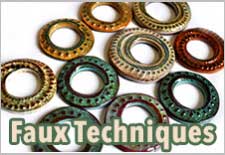
A French word for false or fake. Examples of artistic imitation of different materials and techniques include faux bone, faux jade, faux amber, faux stained glass |
|
| |
Filigree
Originally, a jewelry technique when an intricate design is formed using metal wire pieces soldered together. Picture of a polymer clay pendant with metal filigree part (tutorial). Also: Polymer clay filigree is formed by strings of clay applied in coils or freeform shapes onto polymer clay or other surface to create a textured design. |
|
| |
FIMO
A brand of Polymer Clay. Available in two types, Fimo Classic and Fimo Soft. Refer to the different brands of polymer clay page. |
 |
| |
Findings
The mechanical parts of jewelry making; clasps, pin backs, earring parts and more.
|
 |
| |
Finish
Any way of smoothing the surface or giving a shine including sanding and buffing, or added glosses and glazes. Compatible products include those made by polymer clay manufacturers, Future Acrylic Floor Polish, Rust-Oleum Waterbased Varathane |
 |
| |
Flattening
The act of rolling polymer clay using a roller, brayer or a pasta machine. This movement transforms polymer clay into sheets according to your preferred thickness. |
.jpg?id=7647682) |
| |
Food Processor
A kitchen utensil for chopping food. Some polymer clay artists use it to condition stiff clay. You can find more details on conditioning polymer clay in this page. |
|
G
|
|
Back to top |
| |
Glitter
Glitter is a product used by crafters and designers to create a sparkling or shimmering effect. Glitter is primarily composed of very tiny flecks of glass, stone, paper or plastic, although polyester is perhaps the most common material used in modern glitter production
|
 |
| |
Glue/Adhesive
An adhesive, or glue, is a mixture in a liquid or semi-liquid state that adheres or bonds items together.
In polymer clay Liquid clays are probably the best and strongest glue for polymer clay. they must be baked to cure.
Reactive synthetic glues (epoxy, polyurethane, urea resin & resorcinol)
formulated from synthetic components, cure primarily by chemical reaction.Silicone glues such as E6000 or Goop are very thick clear glue flexible after drying.
See also white plastic glue.
|
 |
| |
Glow in the Dark Clay
luminescent Polymer Clay that glows in the dark. Available from different manufacturers. |
 |
| |
Gold leaf
Thin sheets of composite metal stored between tissue paper, used to create a crackle finish when stretched, used in Mokume Gane with translucent clay. Gold leaf or sometimes copper or silver comes in extremely thin sheets that you can apply directly on polymer clay before or after baking. Because gold leaf will tarnish over time, be sure to use a sealant. |
 |
| |
Gold Leafing Pen
Same as above, in pen style. |
 |
| |
Granitex
Brand of Polymer Clay imitating the look of stone. This clay contains tiny fibers and comes in various colors. This clay is very similar to Sculpey III in its qualities. You can find more details about types of clay in this page. |
 |
| |
Grater
A kitchen tool used for texturing and grate cured clay. When using such a tool, please dedicate it to clay only and buy a new one for your kitchen. |
 |
| |
Grit
Degree of coarseness in sandpaper or powders; low numbers such as 60 are very coarse and range to superfine automotive grade at 1200 and 2000. Also available in paper sheets and in pads.
|
 |
| |
Guild
Group of individuals who come together for a common purpose; the National Polymer Clay Guild and local guilds are a great way to share and exchange information and experiences |
|
H
|
|
Back to top |
| |
Heat Gun
A heat gun is a device used to emit a stream of hot air. They are superficially similar in shape and construction to a hair dryer, though they run at much higher temperatures. They are often found in physics, materials science, chemistry, engineering, and polymer clay mostly for curing.
Handle with caution due to extreme heat.
|
|
I
|
|
Back to top |
| |
Image Transfer
The process of moving an image from a piece of paper onto polymer clay. The transfer occurs when either the top layer of paper or the color pigments (such as color pencil or printer inks) are shifted from the original image onto the surface of polymer clay. |
|
| |
Inclusion
An inclusion or infusion is anything that is mixed into polymer clay to alter its color or texture. Inclusions are most commonly added to translucent or partially translucent clay, but they may be added to any clay, though in opaque clay they will only show on the surface.
Materials other than polymer clay mixed into polymer clay such as – glitter, mica flakes, sand, spices, fibers and many more. |
|
| |
Ink (Alcohol)
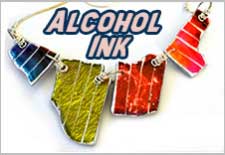
Alcohol inks (such as the Piñata series from Jacquard and the Adirondack series from Ranger) are especially popular with polymer clay artists for their vivid, transparent colors and the numerous effects they can achieve. |
|
| |
Inlays
Different objects pressed or fitted into surface. For polymer clay these objects include: beads, stones, shells, pearls, pieces of glass, etc. |
|
J
|
|
Back to top |
| |
Jelly roll
Spiral cane made with two colors rolled up and sliced; like a cinnamon bun |
 |
K
|
|
Back to top |
| |
Kato
A brand of Polymer Clay. It is one of the strongest clays on the market and my personal preference. Check the page on different types of polymer clay |
 |
| |
Kemper Cutters
Specialized cutters for clay - tiny shapes and assortments from Kemper |
 |
L
|
|
Back to top |
| |
Leaching
A process of reducing the amount of plasticizer in clay. See more about leaching in page on conditioning polymer clay. |
|
| |
Liquid Clay
Polymer Clay in a liquid form. Liquid polymer clay are available in different brands (Sculpey, Kato). Used for bonding pieces of raw and/or cured polymer clay, as a glue for findings, as a paper transfer medium, as Clay Softener, etc. Liquid clay will be baked quite clear on glass and creates flexible firm of clay. It has to be baked under similar conditions as regular polymer clay to cure. |
 |
| |
Log
Cane component like a snake/cylinder but thicker, also sometimes refers to canes. |
 |
M
|
|
Back to top |
| |
Makins Clay
see Air-Dry Clay. |
|
| |
Marbling/Marbelize
The incomplete mixing of two or more colors that creates the appearance of marble or stone. |
|
| |
Mica Powders
Mica powders are non-toxic and color fast, with a neutral pH, and though you wouldn't want to purposefully inhale them, they are less dangerous than metal pulvers. Available in a wide array of colors, mica powders have numerous uses for polymer clay artists as well as those who work in other media. They can be applied dry to the surface of raw clay, mixed into raw clay, painted onto raw or cured clay (though most will have to be mixed into a moist medium, first), and so on. Most surface applications will need a coat of polymer clay-friendly finish to prevent the powders from gradually rubbing off.
You can apply the powder with your finger or a brush and it can be cured.
|
|
| |
Mica Shift
A technique for metallic and pearl Polymer Clays, when mica powders present in these clays are aligned in different directions forming monochromatic designs with holographic effects. |
|
| |
Millefiori/Millefiore
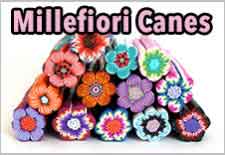
A technique originally used by glass-makers as early as the 1-st century in Egypt, and further defined in Venetian glass in 19-th century. Millefiori means a thousand flowers. The design is formed using canes. You can find 9 polymer clay millefiori tutorials and some freebies in PolyPediaOnline. |
 |
| |
Metallic Clay
Polymer clay containing mica particles to give the clay high shine of metal (comes in gold, silver, and copper colors and is available from different manufacturers). |
|
| |
Metallic Leaf
Just as the name implies, metal leaf is made of actual metal. It is possible to purchase real gold, silver, and copper leaf, as well as "composition leaf", which is made of cheaper metals that simulate the look of gold, silver, and copper. Imitation leaf also comes in variegated color patterns.
|
 |
| |
Metallic Powders
Usually, finally ground metal powders with a gum powder, available from different manufacturers. These powders are usually more expensive than Mica Powders. Sometimes, mica powders in metallic colors are referred to as metallic powders.
|
|
| |
Mokume Gane
A Japanese metal smithing technique adapted to polymer that uses clay sheets stacked and layered with metallic foils to form "loaves". Areas are raised or lowered with impressions from top or bottom and a blade is used to slice thin pieces horizontally from the top. |
|
| |
Molds
A negative relief impression that allow replication using clay pressed in and pulled out; can be made using polymer clay or silicone compounds, metal, wood etc. |
 |
| |
Mosaic
A design formed by many small colored tiles. Both raw and cured polymer clay may be used to make the mosaic tiles. |
|
| |
Mould
See Mold. |
|
| |
Motor
See pasta machine |
|
N
|
|
Back to top |
| |
Needle Tool
A pointed tool used for piercing, texturing, manipulating small pieces of clay, etc. There are commercial needle tools available or you can just make your own by putting a clay handle on a big needle. Check my free tutorial for making Natasha Beads Needles |
 |
O
|
|
Back to top |
| |
Oil Paints
Oil paints can be used for most of the same purposes as acrylic paints, with one notable exception: Because oil paints take so long (at least six months) to dry completely, there's no sense in even trying to use them for crackling. Since it takes oils so long to dry, you shouldn't cover them with any sort of varnish, which will prevent them from ever drying thoroughly. |
|
P
|
|
Back to top |
| |
Pardo
A brand of Polymer Clay. It is the newest clay on the market, produced by Viva Decor(Germany). It has no odor before, during, and after baking and comes in 70 beautiful colors. Made with bees wax, it contains no phthalates. When baked, it is strong and flexible, but in its raw form it is a bit soft for millefiori canes. |
 |
| |
Parchment/baking paper
Baking parchment is sold by the roll in most places that sell baking supplies. Parchment prevents the baked goods from sticking in the pan. This stick-prevention makes it useful for polymer clay, too. Parchment paper can be used for many of the same applications as wax paper. Parchment paper is less slippery than wax paper, which may make it better than wax paper for some purposes. Baking parchment will not absorb plasticizers from polymer clay, so it is suitable for storing uncured clay.
|
 |
| |
Pasta Machine
Rolling device designed for making noodles, and used with polymer clay to condition, blend colors, texturize and create even sheets of clay of 7-9 variable thicknesses. Comes with hand crank and removable noodle cutters that will cut raw or cured into strips. A motor is also available.
Having a pasta machine isn't essential but having one sure does make a lot of clay things much quicker and easier.
|
 |
| |
Pastels (oil based crayons)
Pastel is an art medium in the form of a stick, consisting of pure powdered pigment and a binder. The pigments used in pastels are the same as those used to produce all colored art media, including oil paints; the binder is of a neutral hue and low saturation. Used to color and tint polymer clay. |
 |
| |
Patina
Originally a layer of oxidized metal naturally formed over time on the surface of a metal object (green compound on copper, for example). Artificial patinas are often deliberately added by artists, and are not limited to metal surfaces. See also Antique. |
|
| |
Piercing
The act of making holes in beads, sheets, etc. |
 |
| |
Pigment
Coloring agent |
|
| |
Pigment inks
Pigment inks are used often directly on paper or with embossing powders, opaque colors and metallics. Apply to stamp and press directly into clay, sets when baked. Can be stamped on cured clay and cured in a second baking. Test colors and opacity to ensure desired results and durability. |
|
| |
PearlEx Powders
Brand name for a line of mica powders made by Jacquard.
See Mica Powders. |
|
| |
Photo copy transfer
See image transfer. |
|
| |
PMC (Precious Metal Clay)
Clay-like substance containing metal particles suspended in plasticizers. This is NOT Polymer Clay. PMC has to be fired at high temperatures (above 800F) produced by a kiln or a torch while polymer clay may be cured in a regular oven (requires 275 F). Once fired, PMC object will look like silver or gold (depending on its type). |
|
| |
Plastic Bags
Plastic wrap works great to help protect those beautiful canes or polymer clay sheets that you worked long and hard to create.
You can read more about polymer clay storage in this page |
|
| |
Plasticiser
Any of a group of organic substances used in plastics to impart viscosity, flexibility, softness, and other qualities, an active material in polymer clay. |
|
| |
Polishing
see Buffing. |
|
| |
Powders
Like liquid colors, powdered colors can be used in a variety of techniques with polymer clay, either as surface treatments or as inclusions in solid or liquid clay. Powders can be used to give a black bead the shimmer of silver, to convincingly "brown" a miniature loaf of bread, to tint translucent clay in a rainbow of colors, and much more.
See also Mica Powder, Embossing Powder, Eye Shadow, Chalk, Food Color Powder |
 |
| |
Polymer Clay
A modern modeling compound composed primarily of PVC resin, plasticiser, and pigments as well as other fillers, It is soft and pliable when raw, and becomes hard when cured. Items sculpted out of polymer clay are waterproof and fade-resistant. |
 |
| |
Pliers
Some of the useful tools jewelry-makers use: round nose pliers-for making round wire loops, Flat nose pliers-for gripping wire, making right-angle bends in wire, etc. Chain nose pliers-for gripping and bending wire, Crimping pliers-for securing crimp beads.
With a good pair of wire snips and pliers, you can turn a piece of wire into all sorts of useful jewelry findings (jump rings, ear wires, pendant bail) or even make an exquisite wire-wrapped pendant. |
 |
| |
Plugs
Short fat rolls of clay, sliced and manipulated before reduction |

|
| |
Premo
A brand of Polymer Clay. This is a very versatile type of clay, suitable for all polymer clay techniques and comfortable to work with. Check out page on brands of polymer clay. |
 |
| |
Punches |
|
| |
Push Mold
See Mold. |
 |
Q |
|
Back to top |
R
|
|
Back to top |
| |
Reduction
Squeezing and compressing the cane in on itself as the cane is also stretched to lengthen it causes the scale of the design to become smaller. This can be done a little, or a lot.
A PolyPediaOnline TV video shows how to reduce 3 types of cane - round, triangle and rectangle |
 |
| |
Release agent
Use to prevent things from sticking to one another – such as powders or cornstarch, use to prevent stamps from sticking to clay when impressed.
Water – spray on clay before pressing a texture sheet/stamp. |
|
| |
Resin
Resin is a hydrocarbon secretion of many plants, It is valued for its chemical properties and associated uses, such as the production of varnishes, adhesives, and food glazing agents; In polymer clay used for a nice glossy finish. Some are self hardening, some are UV hardening. Self hardening are 2-part which need to be carefully mixed. While the UV resin is a single bottle of resin that needs no mixing and means you can do a single piece of jewelry without mixing the 2 materials. |
 |
| |
Retro (millefiori canes)
The RETRO cane is the result of pushing layers of color through a clay gun. The block is reduced and recombined to make a complex square cane that looks like something out of the 1960's. |
 |
| |
Ripple Blade
Instead of a straight blade, the Ripple Blade is a wavy blade that was made to cut ripple veggies (right).
|
 |
| |
Roller
A tool used to make thin sheets of polymer clay. Also see Brayer. |
 |
| |
Rolling
A term used when referred to polymer clay placed in a pasta machine and also for other purposes. |
 |
| |
Rhinestones
A rhinestone is a diamond simulant made from rock crystal, glass or acrylic. Used with polymer clay for decoration.
|
|
| |
Rubber Stamps
Comes in various types and kinds, photo on the right shows clear stamps. You are welcome to read more about stamps in the "how to start" page |
 |
| |
Ruler
The good old tool used for measuring length of canes, sizes, etc. |
 |
S
|
|
Back to top |
| |
Sanding
A process of making the surface of polymer clay smoother by rubbing it with sand paper. |
|
| |
Scissors
The old useful tool, can be used with polymer clay too, cutting thin sheets of clay or image transfers. |
|
| |
Sculpey III
Brand of Polymer Clay. It is a good clay for beginners and kids due to its softness, although it is too soft for some techniques (such as Millefiori, for example). Other types of Sculpey include Sculpey Original, Sculpey Soft, and Super Sculpey. Check types of polymer page for more details |
 |
| |
Seed Beads
Seed beads are uniformly shaped, spheroidal beads ranging in size from under a millimetre to several millimetres. "Seed Bead" is a generic term for any small bead. Usually rounded in shape. Used with polymer clay as decoration. Most of them are not oven proof. |
 |
| |
Shapelets
Cutting templates used to obtain uniform shapes out of polymer clay Sheet. |
 |
| |
Sheets
Flat, even layers of clay, made by rolling the clay with an acrylic rod, a brayer, or a pasta machine. |
 |
| |
Slamming
Forcefully throwing the cane down on a flat surface helps "waking up" canes that are slow to move. |
|
| |
Slicing
The process of cutting a millefiori cane into thin pieces |
 |
| |
Snakes
Rolled out pieces of clay that are long with a round diameter. Also referred to by other shapes as in "triangle", "teardrop" or "square" snakes. |
 |
| |
Spiral
Curled image inside a cane made by rolling up two colored sheets in a jelly roll shape. |
 |
| |
Stamp
Texture tool with a positive or raised image that allows the design to be impressed into the surface of clay or used with inks or embossing agents to pattern the surface, see also rubber stamp. |

|
| |
Straws (drinking straws)
Used to pierce polymer clay pieces for holes and for texturing.
|
 |
| |
Stripes
Clay pieces that can easily be flatten from a snake of clay by pressing with your thumb or a roller. |
 |
| |
Skinner Blend
A technique developed by Judith Skinner for creating polymer clay Sheetwith smooth gradations of color. |
 |
T
|
|
Back to top |
| |
Texture Sheets
Plates (made out of rubber or soft plastic) with different textures on them which can be pressed into the clay using a Pasta Machine or a Roller. |
 |
| |
Texturing
A process of creating a texture on the surface of polymer clay using Texture Plates, fabric, sand paper, tree bark, and other objects. |
|
| |
TLS (Translucent Liquid Sculpey)
A brand of Liquid Clay (right) |
 |
| |
Tooth Picks
A toothpick is a small stick of wood, plastic, bamboo, metal, bone or other substance. Used in polymer clay for piercing holes or as base and armature for supporting sculpturings. |
 |
| |
Transferring
see Image Transfer. |
|
| |
Translucent
Admitting or diffusing light so objects can not be seen clearly through it. Refers also to clay with no pigments or fillers that can be sliced very thin and buffed almost clear |
|
| |
Transparent
Transmitting of light so objects can be seen clearly through it |
|
| |
Trimming
The process of cutting leftovers or aligning the clay to the right position/thickness/quantity |
 |
U
|
|
Back to top |
| |
Ultralight
Ultralight (by Sculpey Polyform) is a unique clay, it is very lightweight. This clay is extremely soft and easy to knead, but it becomes very hard after baking. This clay is available only in white, but it can be painted after baking. It makes a nice filler for larger polymer clay beads. |
 |
V
|
|
Back to top |
| |
Varnish
see Acrylic Sealant. |
|
| |
Vessel
A container, usually round (such as a vase or a bowl). |
 |
W
|
|
Back to top |
| |
Wet Sanding
A process of Sanding polymer clay with wet sandpaper. |
 |
| |
White Plastic Glue
"White" glues, most white glues are a suspension of polyvinyl acetate (PVA) resin in water, also tacky glues, "wood glues", sizing glues, etc
have medium strength and is water "resistant", flexible and clear after drying.
Can be used for many things with clay, but not good for when real strength is required, often used as an undercoating to prepare an object to be covered with clay (and seals surfaces).
|
 |
| |
Work Surface
Any surface on which you work with polymer clay. Examples of good work surfaces include ceramic tile, glass, marble, waxed paper, etc. |
|
| |
Wavy Blade
see ripple blade
|
 |
| |
Wrapping
The process of placing a sheet of clay around a piece, a snake or a millefiori cane |
 |
X
|
|
Back to top |
| |
X-acto-knife
A tool with sharp disposable blades used for carving and cutting. |
 |
Y
|
|
Back to top |
Z
|
|
Back to top |